


Inside Heroes
vol.2

Architecture that Breathes with the Landscape
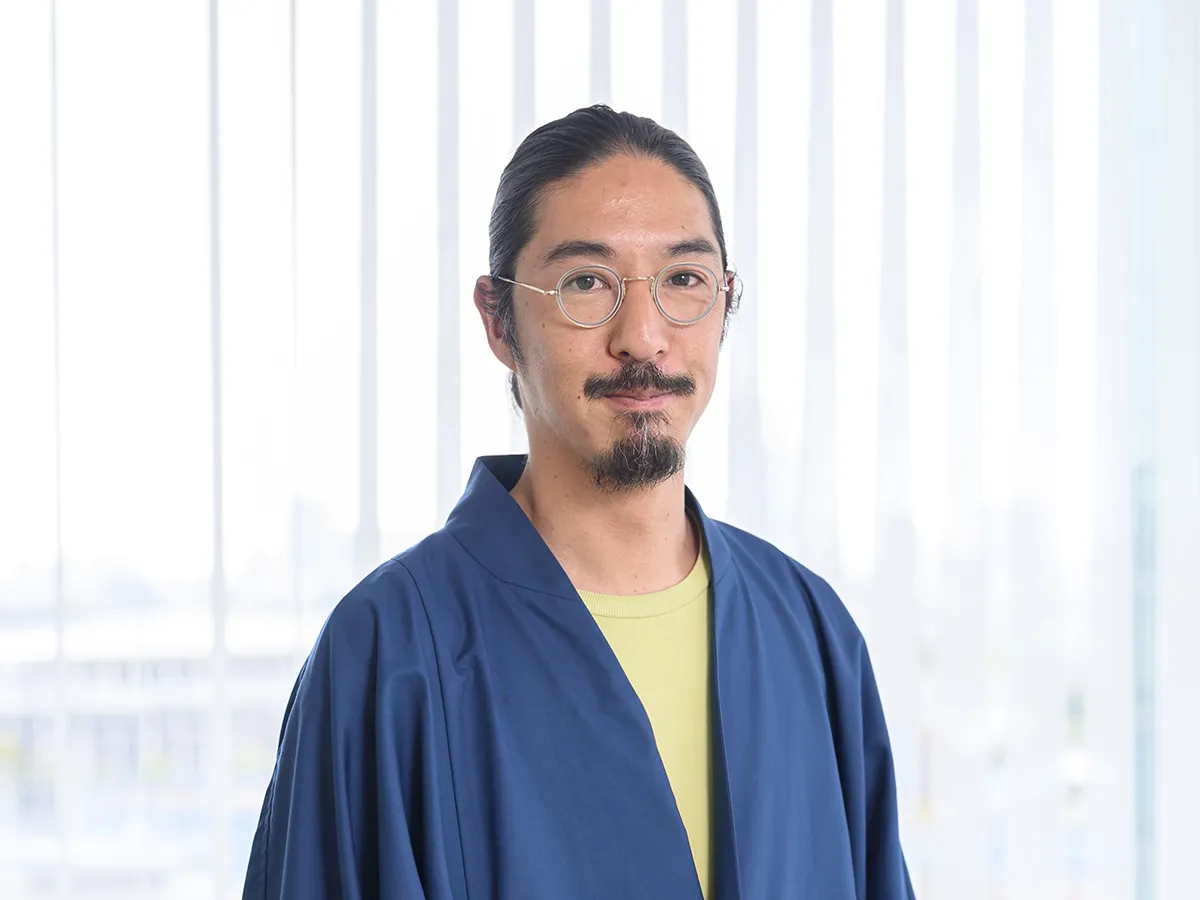
A Message to Our Visitors
At first glance, the Themed Pavilion may appear to take on an unfamiliar form.
Yet within each element resides the quiet logic of nature.
Emerging from a careful reading of the local landscape of Kamiseya, this architecture proposes a new expression of timber construction.
As if entering a great tree, we invite you to move through the space and experience the gentle sensation of being immersed in this place’s natural richness.
The Vision Behind the Design Supervision
— How did you feel when you were invited to take on this role?
Araki:
International expositions offer a rare environment where bold and experimental ideas are welcomed. As someone drawn to new and challenging endeavors, I was genuinely excited when I was approached about this project.
At the heart of this pavilion is the challenge of creating a large-scale timber space using CLT (Cross-Laminated Timber)—an innovative, environmentally conscious material. I felt a strong desire to see the vision drawn in the design fully realized at architectural scale, and I continue to visit the site regularly to follow its progress.
Architectural Intelligence Inspired by Plant Strategies
— What inspired the pavilion’s distinctive form?
Araki:
The design began with the idea of “architecture like a plant”—or even “architecture as a living organism.”
I have long been fascinated by the forms and systems found in nature. As a child, I would spend hours observing forests on my way home from school.
These early experiences, along with insights gained from traditional Kesen carpenters encountered during post-disaster reconstruction projects in Tohoku, became key sources of inspiration.
Their traditional techniques reveal a deep structural logic: beams supporting the roof are arranged so that they gradually become smaller toward the top, reducing weight and increasing stability.
This principle—placing heavier elements below and lighter ones above—ultimately led to a form that echoes the natural structure of a tree: a strong trunk branching upward into increasingly delicate extensions.
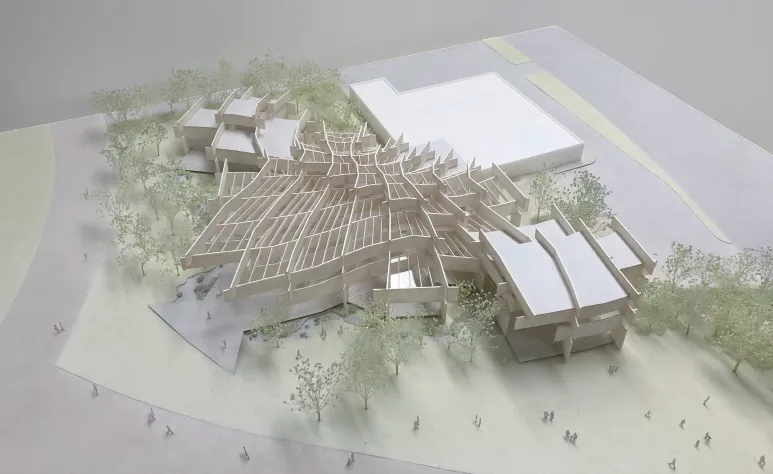
Beam Concept
(Lower levels are thicker and longer; upper levels become thinner and shorter)
Illustration for reference only.
— We understand there is also a unique philosophy behind the underground structure.
Araki:
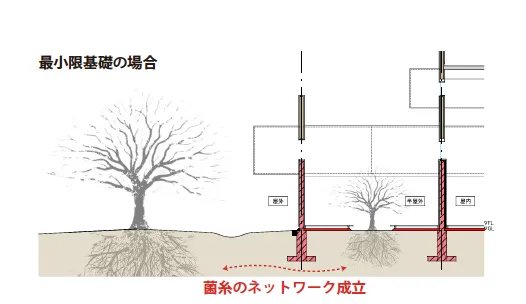
Yes. Even in the foundation—the point where building meets earth—we sought inspiration from plant life.
In conventional construction, foundations often cover the ground entirely with concrete. In this project, however, we minimized the foundation footprint wherever possible, limiting it to areas that would not affect the indoor environment.
This approach not only reduces material use and environmental impact but also allows the soil to remain continuous. By doing so, we aim to echo the underground networks of plants—their roots extending, connecting, and sharing nutrients beneath the surface.
Leaving portions of the ground exposed, without concrete, presented unprecedented challenges. Yet we believe that such careful attention to detail is what ultimately gives rise to truly comfortable and meaningful spaces.
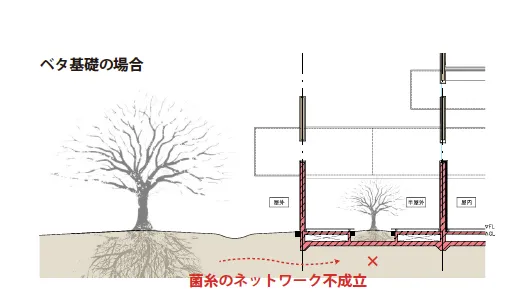
©KENGO KUMA & ASSOCIATES
©KENGO KUMA & ASSOCIATES
Foundation Concept
(Comparison between the full-slab foundation and the strip foundation used in this project)
Illustration for reference only.
— How does this architecture harmonize with the environment of Kamiseya?
Araki:
A tree’s form—its roots, trunk, and branches—is shaped by the specific conditions of the land in which it grows.
This architecture follows the same principle.
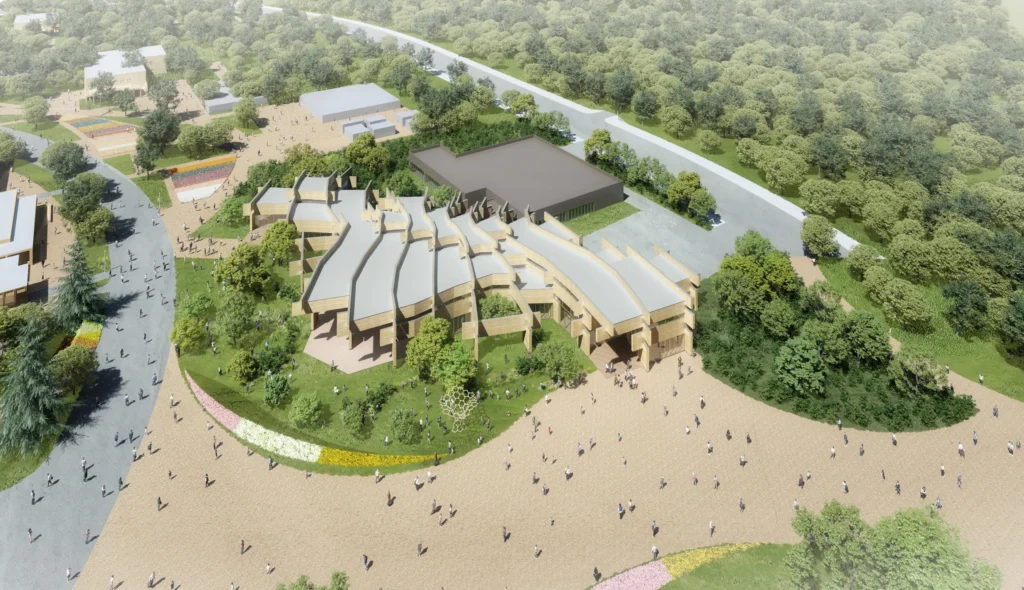
By closely reading the site—its topography, prevailing winds, and patterns of light—the form of the pavilion gradually emerged.
For instance, winds at this site often flow from south to north. In response, the first layer of structural columns is arranged like a flowing current, allowing air to pass smoothly through the building.
Additionally, vegetation planted on the southern side creates a cooling effect through evapotranspiration, forming a natural ventilation system.
Design, in this sense, becomes a process of responding to countless environmental factors—much like a tree adapting its form as it grows.
©KENGO KUMA & ASSOCIATES
Column Concept
(From south to north, the airflow appears like a flowing river)
Illustration for reference only.
Design Director, Kengo Kuma & Associates
Kai Araki
Kai Araki joined Kengo Kuma & Associates in 2012 and has since been involved in the design of a wide range of public architecture and pavilions in Japan and abroad.
For the International Horticultural Expo 2027 (Yokohama), he serves as Design Supervisor of the Themed Pavilion.
Listening closely to the underlying principles of nature, he is dedicated to creating spaces that harmonize with their environment and offer a sense of quiet comfort.